The IVF process step by step can feel overwhelming for couples who are exploring fertility treatment for the first time. In vitro fertilization, commonly known as IVF, is the most widely used assisted reproductive technology (ART) in the world today. This complete guide walks you through every stage of the IVF procedure, from your very first consultation with a fertility specialist to embryo transfer and the pregnancy test that follows. Whether you are dealing with blocked fallopian tubes, unexplained infertility, male factor infertility, or age-related fertility decline, understanding the IVF process step by step helps you prepare mentally, physically, and financially. According to the Centers for Disease Control and Prevention (CDC), roughly two percent of all births in the United States now result from assisted reproductive technology. With modern advances in embryo culture, genetic screening, and frozen embryo transfer, IVF success rates have improved significantly over the past decade. Let us explore each phase of this life-changing journey in simple, easy-to-understand language.
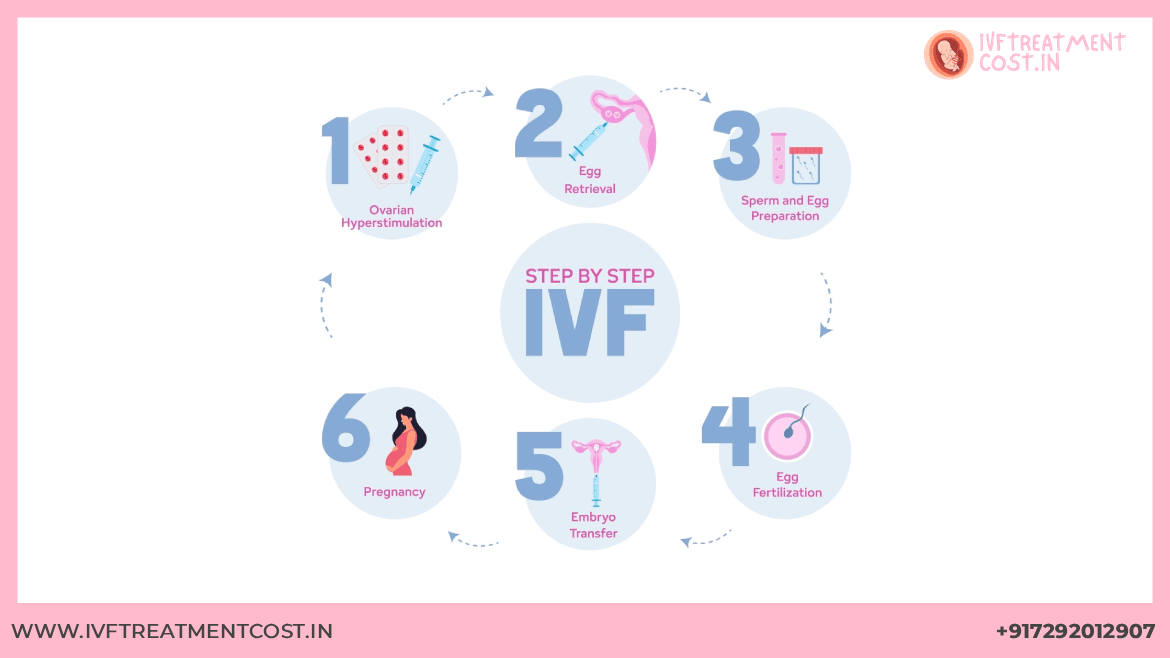
The IVF process step by step typically involves five main stages: ovarian stimulation, egg retrieval, fertilization in the laboratory, embryo culture and selection, and embryo transfer. Each stage requires careful monitoring by a fertility specialist. The entire cycle usually spans two to six weeks from the start of hormone medications to the pregnancy blood test. Knowing what to expect at each phase reduces anxiety and helps patients make informed decisions about their fertility care. Success depends on factors like age, egg quality, sperm health, and the expertise of your chosen IVF clinic.
What Is the IVF Process Step by Step and Who Needs It?
In vitro fertilization (IVF) is a multi-step fertility treatment in which eggs are collected from the ovaries and fertilized with sperm inside a laboratory. The term “in vitro” literally means “in glass,” referring to the lab dish where fertilization takes place outside the human body. Once a healthy embryo develops, it is transferred back into the uterus with the hope that it will implant and grow into a successful pregnancy. IVF was first successfully performed in 1978 by Dr. Robert Edwards and Dr. Patrick Steptoe in England, leading to the birth of Louise Brown, the world’s first “test-tube baby.” Since then, millions of babies have been born through this technology worldwide.
Not every person struggling with fertility needs IVF. Doctors usually recommend IVF when other, less invasive treatments such as ovulation induction, intrauterine insemination (IUI), or surgery have failed. Common reasons patients pursue IVF include blocked or damaged fallopian tubes, severe male factor infertility such as low sperm count or poor sperm motility, endometriosis, polycystic ovary syndrome (PCOS) that does not respond to medication, diminished ovarian reserve, unexplained infertility after thorough testing, genetic disorders where preimplantation genetic testing (PGT) is needed, and same-sex couples or single parents who need donor gametes or a gestational carrier. Understanding whether IVF is the right path begins with a thorough evaluation by a reproductive endocrinologist.
Detailed IVF Process Step by Step: From Consultation to Pregnancy
Step 1 – Initial Consultation and Fertility Testing in the IVF Process
The first step in the IVF process is a comprehensive fertility evaluation. During this appointment your reproductive endocrinologist will review your medical history, conduct a physical examination, and order a battery of diagnostic tests. For women these tests typically include blood work to check hormone levels such as follicle-stimulating hormone (FSH), anti-Müllerian hormone (AMH), and estradiol, as well as a transvaginal ultrasound to count antral follicles and assess uterine health. For men, a semen analysis evaluates sperm count, motility, morphology, and volume. Additional tests may include a hysterosalpingogram (HSG) to check whether the fallopian tubes are open, genetic carrier screening, and infectious disease panels. Based on these results the doctor designs a personalised IVF treatment plan tailored to your specific diagnosis and medical profile.
Step 2 – Ovarian Stimulation: The Foundation of the IVF Process Step by Step
Once the treatment plan is in place, the next phase of the IVF process step by step is ovarian stimulation, also called controlled ovarian hyperstimulation (COH). In a natural menstrual cycle your body usually produces one mature egg. However, IVF requires multiple mature eggs to increase the chances of creating viable embryos. Your doctor will prescribe daily injectable fertility medications known as gonadotropins, which stimulate the ovaries to develop multiple follicles simultaneously. Common medications include follitropin alfa, follitropin beta, and menotropins. During this phase, which lasts approximately eight to fourteen days, you will visit the clinic every two to three days for blood tests and transvaginal ultrasounds. These monitoring appointments allow the medical team to track follicle growth and adjust medication doses as needed. When the leading follicles reach an optimal size of about seventeen to twenty millimetres, a trigger shot of human chorionic gonadotropin (hCG) or a GnRH agonist is administered to finalise egg maturation.
Egg Retrieval, Fertilization, and Embryo Transfer in the IVF Process Step by Step
Step 3 – Egg Retrieval (Oocyte Pick-Up): Approximately thirty-four to thirty-six hours after the trigger shot, the egg retrieval procedure takes place. This is a minor surgical procedure performed under light sedation or anaesthesia. Using transvaginal ultrasound guidance, the fertility doctor inserts a thin needle through the vaginal wall into each ovary and aspirates the fluid from the follicles, collecting the eggs contained within. The entire procedure takes about fifteen to thirty minutes. Most patients can go home the same day and return to normal activities within a day or two. The number of eggs retrieved varies widely depending on age, ovarian reserve, and response to medication, but an average retrieval may yield anywhere from eight to fifteen eggs.
Step 4 – Fertilization in the Laboratory: Once the eggs are collected, they are taken to the embryology laboratory, where they are combined with sperm. There are two main fertilization techniques. In conventional IVF, the eggs and sperm are placed together in a culture dish and fertilization occurs naturally. In intracytoplasmic sperm injection (ICSI), a single healthy sperm is injected directly into each mature egg using a microscopic needle. ICSI is typically recommended when there is severe male factor infertility, previous fertilization failure, or when a limited number of eggs are available. The embryologist checks the eggs the next morning to confirm how many have successfully fertilized.
Step 5 – Embryo Culture and Selection: Fertilized eggs, now called embryos, are kept in a carefully controlled incubator that mimics the conditions of the human body. Over the next three to six days, embryologists monitor embryo development. By day five or six the healthiest embryos typically reach the blastocyst stage, which contains about one hundred cells. Many clinics now use time-lapse imaging technology that takes photographs of the developing embryos every few minutes, allowing embryologists to evaluate development without disturbing the culture environment. If preimplantation genetic testing (PGT-A) is planned, a small biopsy of cells is taken from the outer layer of the blastocyst and sent for analysis to check for chromosomal abnormalities. This step helps select the embryo most likely to lead to a healthy pregnancy.
Step 6 – Embryo Transfer: The embryo transfer is the final and often most anticipated step in the IVF process. It is a simple, painless procedure that does not require anaesthesia. The doctor uses a thin, flexible catheter to place one or two selected embryos into the uterus through the cervix, guided by abdominal ultrasound. After the transfer, you will rest for a short period before going home. The two-week wait (TWW) that follows is often the most emotionally challenging part of the IVF journey. About ten to fourteen days after the transfer, a blood test measuring beta-hCG levels will confirm whether the embryo has implanted and a pregnancy has begun.
“The desire to have a child is one of the most fundamental human instincts, and I am proud that IVF has helped so many people to fulfil that dream.”— Sir Robert Edwards, Nobel Laureate & Pioneer of IVF
“After three years of trying to conceive naturally and two failed IUI cycles, we decided to try IVF. The process felt scary at first, but once our doctor explained the IVF process step by step, I felt empowered and informed. The injections were manageable, and the clinic staff held my hand through every ultrasound and blood draw. On our first IVF cycle, we retrieved twelve eggs, eight fertilised, and three made it to blastocyst. We transferred one embryo and froze the rest. Two weeks later, the pregnancy test was positive. Our daughter is now fourteen months old, and she is the greatest blessing of our lives. To anyone considering IVF — trust the process and lean on your medical team.”
Tips to Improve Your IVF Success Rate
Following these evidence-based tips can help you optimise your chances during the IVF process step by step:
- Maintain a healthy body weight – Studies show that a BMI between 19 and 25 is associated with better IVF outcomes and improved hormone response.
- Take prenatal vitamins and folic acid – Start at least three months before your IVF cycle begins to support egg quality.
- Reduce stress through yoga, meditation, or counselling – Emotional well-being directly supports fertility health and implantation.
- Avoid smoking, alcohol, and excessive caffeine – These substances negatively affect egg quality, sperm quality, and uterine lining.
- Follow your medication schedule exactly as prescribed – Timing is critical during ovarian stimulation for optimal follicle development.
- Choose a reputable fertility clinic with transparent success rates – Check SART and CDC databases before committing.
- Consider preimplantation genetic testing (PGT-A) – Especially if you are over thirty-five or have a history of recurrent miscarriage.
- Stay physically active with moderate exercise – Avoid high-intensity workouts during stimulation, but gentle movement helps circulation.
- Get adequate sleep of seven to eight hours per night – Sleep quality directly affects hormone regulation and ovarian response.
- Communicate openly with your partner and medical team – A strong support system makes a measurable difference in IVF outcomes.
IVF Success Rates by Age Group
The table below summarises approximate IVF live birth rates per embryo transfer using own eggs, based on national data from SART and the CDC (2023 reporting year):
| Age Group | Live Birth Rate / Transfer | Cumulative Rate (3 Cycles) | Miscarriage Risk |
|---|---|---|---|
| Under 35 | 40 – 50% | Up to 80 – 90% | 10 – 15% |
| 35 – 37 | 30 – 38% | Up to 70 – 80% | 15 – 20% |
| 38 – 40 | 20 – 28% | Up to 55 – 65% | 20 – 30% |
| 41 – 42 | 10 – 18% | Up to 35 – 45% | 30 – 40% |
| 43 and above | 3 – 10% | Up to 15 – 25% | 40 – 50% |
Source: Society for Assisted Reproductive Technology (SART) National Summary Report & CDC ART Success Rates, 2023 cycle data.
IVF Process Step by Step – Timeline Overview
| Stage | Duration | What Happens |
|---|---|---|
| Consultation & Testing | 1 – 4 Weeks | Blood tests, ultrasounds, semen analysis, treatment plan |
| Ovarian Stimulation | 8 – 14 Days | Daily hormone injections, regular monitoring visits |
| Trigger Shot | 1 Day | Final injection to mature eggs; timed precisely |
| Egg Retrieval | 1 Day (15–30 min) | Minor procedure under sedation to collect eggs |
| Fertilization & Culture | 3 – 6 Days | Sperm meets egg in lab; embryos grow to blastocyst |
| Embryo Transfer | 1 Day (10–15 min) | Selected embryo placed in uterus via catheter |
| Two-Week Wait | 10 – 14 Days | Waiting period before beta-hCG pregnancy blood test |
IVF Success Trends: Data from Medically Verified Sources
The following charts are based on verified data published by the CDC and SART. These organisations collect annual outcome data from all reporting fertility clinics in the United States.
Research Paper Citations
1. Olawade DB, Teke J, Adeleye KK, Weerasinghe K, Maidoki M, David-Olawade AC. “Artificial intelligence in in-vitro fertilization (IVF): A new era of precision and personalization in fertility treatments.” Journal of Gynecology Obstetrics and Human Reproduction. 2025 Mar;54(3):102903. doi: 10.1016/j.jogoh.2024.102903. This narrative review explores how artificial intelligence, machine learning, and deep learning may enhance ovarian stimulation protocols, gamete selection, and embryo grading during the IVF process.
2. Choe J, Shanks AL. “In Vitro Fertilization.” StatPearls [Internet]. Treasure Island (FL): StatPearls Publishing; 2023. PMID: 32965939. This clinical reference provides a comprehensive overview of IVF procedures, indications, contraindications, and the interprofessional team approach to managing fertility treatment cycles.
3. Carson SA, Kallen AN. “Diagnosis and management of infertility: a review.” JAMA. 2021;326:65–76. doi: 10.1001/jama.2021.4788. This peer-reviewed article covers the evaluation and treatment of infertility, including the role of IVF when other treatments have failed.
Final Thoughts on the IVF Process Step by Step
Understanding the IVF process step by step is one of the most empowering things you can do when facing fertility challenges. From the initial consultation and diagnostic testing to ovarian stimulation, egg retrieval, fertilization in the embryology laboratory, and finally the embryo transfer, each stage of in vitro fertilization has been refined over decades of scientific research to give you the best possible chance of achieving a healthy pregnancy. While no fertility treatment can guarantee success, knowing what lies ahead helps reduce fear and allows you to focus on what you can control — your health, your mindset, and your choice of a skilled medical team. Whether this is your first IVF cycle or you are preparing for a subsequent attempt, remember that every step brings you closer to your dream of parenthood. The IVF process step by step may be complex, but with the right guidance and support, it is a path that millions of families have walked before you — and found joy at the end.
Frequently Asked Questions About the IVF Process
References and Trusted Resources
- 1. CDC ART Success Rates — www.cdc.gov/art/success-rates
- 2. SART National Summary Report — www.sartcorsonline.com
- 3. NIH StatPearls: In Vitro Fertilization — ncbi.nlm.nih.gov/books/NBK562266
- 4. WHO Fact Sheet on Infertility — who.int/fact-sheets/infertility
- 5. Olawade DB et al., J Gynecol Obstet Hum Reprod. 2025;54(3):102903 — PubMed 39733809
- 6. Carson SA, Kallen AN. JAMA. 2021;326:65–76 — PubMed 34228062
- 7. American Society for Reproductive Medicine (ASRM) — www.asrm.org